Global travel & tourism market to hit 30 billion tourist trips and $16 trillion economy by 2034
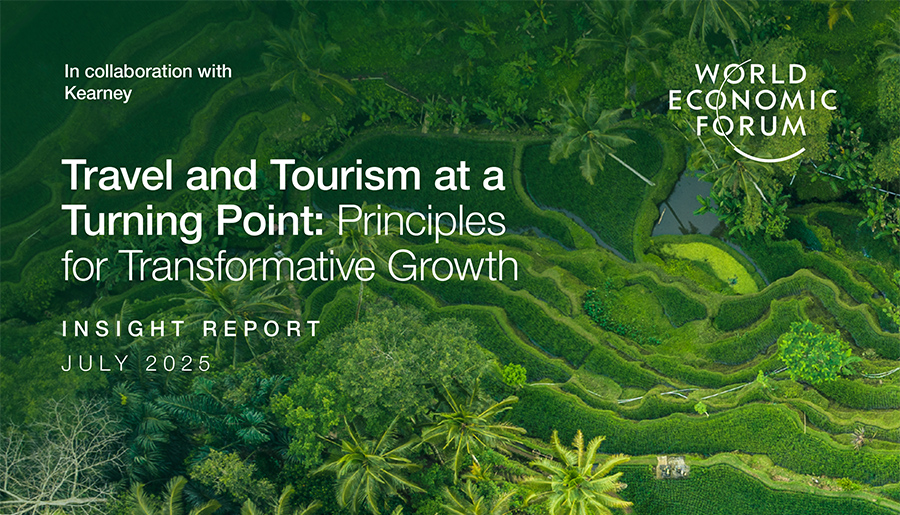
The global travel and tourism industry is poised for sustained growth in the coming years, fuelled by rising consumer interest and increasing access to international travel opportunities. According to a report by the World Economic Forum and Kearney, the industry will reach 30 billion tourist trips annually by 2034.
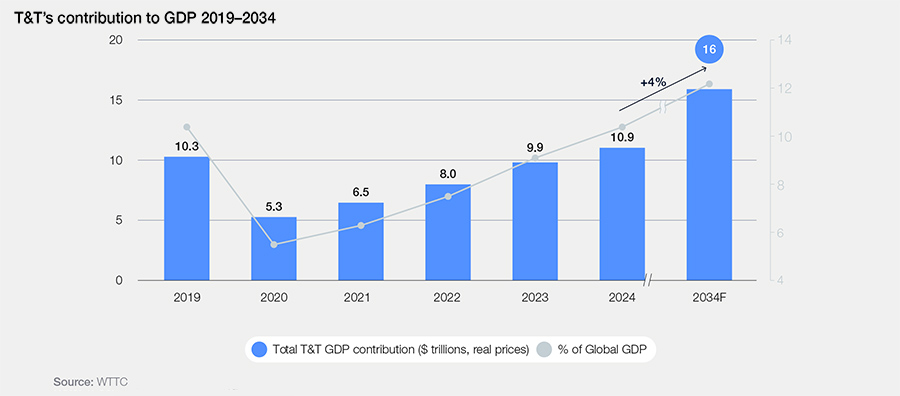
The report also highlights that travel and tourism will contribute approximately $16 trillion to global GDP by 2034, representing more than 11% of the world economy. Currently, the sector accounts for just under 10% of global GDP and supports over 330 million jobs worldwide, but it is growing 1.5 times faster than the global economy.
Although the Covid-19 pandemic significantly disrupted the sector—causing global travel and tourism GDP to fall from $10.3 trillion in 2019 to $5.3 trillion in 2020, a nearly 50% decline – the industry has since shown a robust recovery. While the report outlines several possible future scenarios, the most likely projection is that total travel spending will reach $14 trillion by 2034, culminating in a $16 trillion GDP contribution.
At the same time, the travel and tourism industry is undergoing transformative changes, driven by innovation in business models, rapid technological adoption, evolving industry dynamics, and shifting travel preferences.
Certain segments are experiencing especially rapid growth. Sports tourism is expected to reach $1.7 trillion by 2032, while ecotourism and wellness are projected to grow with double digits through to 2032.
Destinations
Major tourist destinations such as the United States, France, Mexico, Spain, Italy and Brazil will remain the largest contributing nations to the travel and tourism economy. Other countries like Japan, Turkey, Egypt, and Germany are also in the higher echelons of the list.
“These nations have robust tourism sectors with varied attractions and an established infrastructure,” said Børge Brende, President and CEO of the World Economic Forum (WEF).
The fastest growing tourism economies for the years ahead however nearly all sit in Asia. Notably, India and China together are projected to constitute more than 25 percent of all outbound international travel by 2030. As a whole, Asia’s direct travel and tourism GDP contribution is expected to surpass 7% across the region by 2034.
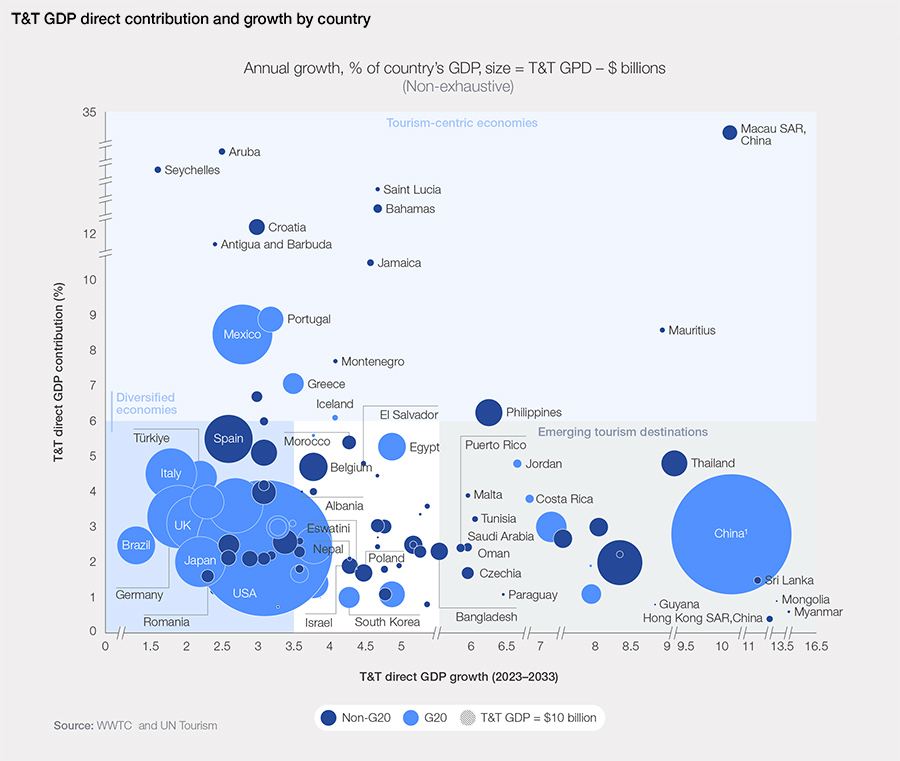
Countries such as Sri Lanka, Thailand and Indonesia are all set for considerable growth, fueled by significant investments in their tourism sectors. This upward momentum is resulting in increased international arrivals, heightened tourism-related business activity, and enhanced global visibility.
Outside of Asia, the UAE and Saudi Arabia stand out as high growth markets – the Middle East’s two economic powerhouses are already quite popular among tourists around the world.
Risks and opportunities
However, the World Economic Forum (a think tank) and Kearney(a global management consulting firm) report also highlights considerable challenges.
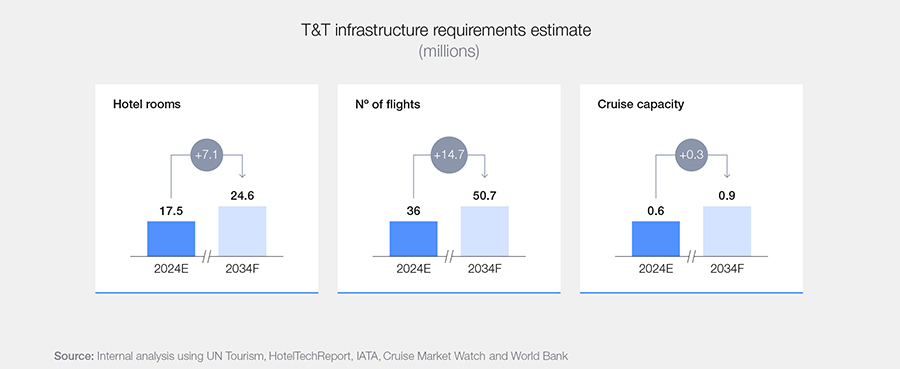
Scaling up is one obvious challenge. To support the boom in travel and tourism, the industry will need to expand significantly – requiring an estimated 7 million new hotel rooms, 15 million additional flights annually and investment in infrastructure capable of supporting 30 billion trips globally.
Another challenge – or concern – is the sector’s climate footprint. Travel and tourism currently contributes to 8% of global greenhouse gas emissions, a figure that could escalate to 15% by 2034 without intervention. And waste generated by tourists is projected to hit 205 million tons annually, equivalent to 7% of the world’s solid waste.
The report calls for countries and destinations to keep their tourism attractions sustainable on the long term, through smart planning and environmental regeneration.
Against this backdrop, WEF President Brende said that the industry stands at a pivotal crossroads. “Realizing the opportunity the industry is facing will require more than incremental change. It calls for a bold reimagining of the systems that underpin travel and tourism, anchored in multistakeholder collaboration. From aligning on sustainable fuel standards to empowering local communities in tourism planning, the time has come to redesign the rules to create a sector that works better for people and the planet.”
“As the industry grows to meet the needs of billions more travellers, it also needs to evolve,” added Bob Willen, Managing Partner and Chairman at Kearney. “That means using technology responsibly, supporting workers and small businesses, protecting the planet, and making sure local communities truly benefit. It’s about creating a travel and tourism sector that’s not just bigger, but works in everyone’s interests.”
link