
How Death Taxes Kill Family Businesses: News Article
I’ve talked a lot in this column over the years about how specific taxes are inefficient, because they discourage what are otherwise good behaviors by taxing them. Property taxes prevent property improvements. Capital gains taxes prevent profitable sales of assets, thus reducing liquidity in the economy. Corporate income taxes cause businesses to engage in expensive accounting tricks to show less profit.
For this column, I’d like to talk about a tax that can’t be avoided because it’s tied to an activity that happens to everyone—the death tax. Vaguely named the “estate tax” by the federal government, it has similar consequences as the others: it forces families to spend lots of time, money, and legal maneuvering to avoid it. And in the event they don’t, it saddles the descendants of these families with a tax burden that can lead to financial ruin and close what would have been multi-generational businesses.
The federal estate tax was first enacted (perhaps unsurprisingly) in 1916 during the Woodrow Wilson administration. It was viewed as a way to fund government programs and curb what some politicians viewed as excessive wealth concentration, by imposing a levy on the transfer of large estates to heirs.
Today, the Internal Revenue Service defines the estate tax as a levy on the transfer of the “taxable estate”—which I’ll dig into below. Basically, a person’s estate—including all assets owned at death, minus debts, deductions, and the federal exemption amount—is taxed at rates up to 40%.
The U.S. isn’t unique in this. The United Kingdom, France, Germany, Japan, and other developed nations impose levies that are arguably more punitive, with top rates exceeding 50% in some countries. But the U.S. system, with its complex exemption thresholds and trust loopholes, is still convoluted.
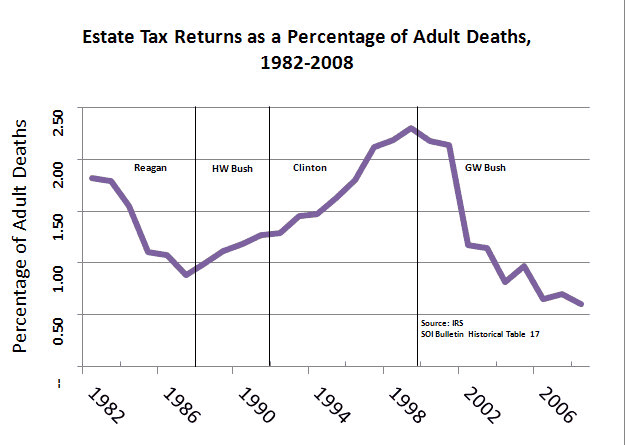
For decades in the U.S., the federal estate tax exemption was merely in the low six figures, while the top estate tax rate got as high as 77%. This harmed family businesses involved with farming, manufacturing and other blue-collar industries. Such businesses are often illiquid: cash-flow-light but asset-heavy. Congressional testimony from that era featured Nebraskan farmers, a California winery and a New York lumber company that had to sell many of their assets to pay their tax bills, causing them to restructure or close.
Recognizing the damage the estate tax was causing, Congress has steadily raised the exemption through the years—it now stands at $13.99 million per person, or $27.98 million for married couples, with an increase slated for 2026. Families whose net worth may eventually exceed these limits often create trusts and “gift” assets into them during their lifetimes. Once the assets are owned by the trust rather than the individual, they’re technically removed from the taxable estate. This not only shields the current value from estate tax, but also removes all future appreciation of those assets from being taxed at death—a major advantage if the assets are expected to grow. Those trust-held assets may still face capital gains taxes if sold, but they are no longer subject to estate tax simply because the original owner passed away.
Given those thresholds, most families can now shield their wealth entirely through trusts. But the trusts themselves come with drawbacks.
First, they’re legally and financially complex; forming them often requires hiring a small army of estate attorneys, accountants, and financial planners who can run up six-figure bills. The trusts that have the biggest tax advantages must be irrevocable—meaning they can’t be changed once finalized–and thus must have perfect language the first time.
Second, since trusts are premised on “gifting,” the parents must relinquish control of their assets during their lifetimes—a huge emotional and financial leap. The trustees (often the children) are, depending on trust structure, supposed to use the trust’s income to support the parents in retirement, an arrangement that can sour family relationships.
Third, the trust structure often complicates business operations. When company shares are divided among trusts, it can limit the ability to raise loans, take on investors, or even sell the business. Some trusts contain rigid bylaws about profit retention, income distribution, and asset transfers that make it harder for businesses to operate dynamically.
In other words, the very act of avoiding the estate tax can make it harder for a family business to function.
President Donald Trump’s 2017 Tax Cuts and Jobs Act doubled the estate tax exemption, and increases since then have been made permanent by later legislation. The Trump administration argued—correctly—that estate taxes hurt small businesses while contributing little to overall federal revenue (less than 1% of all receipts).
But even with the exemptions in place (it will reach $15 million for individuals and $30 million for couples in 2026), some crucial American businesses will rise beyond these thresholds even after enduring the convoluted process of creating family trusts.
The simplest policy would be to abolish the estate tax entirely. Parents who have built wealth over decades have already paid taxes—on income, capital gains, properties, and every other levy imaginable. Taxing them again merely because they died isn’t just inefficient—it’s wrong.
The current system punishes responsible families who save and build long-term enterprises. It encourages elaborate legal schemes instead of straightforward inheritance.
Creating trusts and gifting assets may be a workaround to the estate tax, but it’s not as good as just ending the tax.
Cover image use authorized under the Creative Commons Attribution-ShareAlike 3.0 Unported license.
link