




Question: What is “family business philanthropy”?

There’s literature about individual philanthropy and corporate philanthropy, but not much about family business philanthropy, although the phenomenon is popular in some countries, such as Lebanon. Because of the family element, you have “socioemotional wealth” along with economic wealth – you always have nonprofit goals in a for-profit company. In contrast, corporations have financial goals mostly, satisfying shareholders, creating economic benefits and so on, and philanthropy or nonprofit goals are rarely primary.
Q: What are you researching regarding family business philanthropy, and how does it compare to types of philanthropy in Canada?

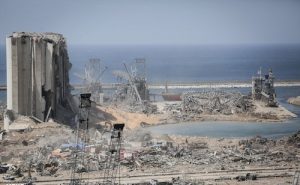
“After the Beirut port explosion, in 2020, there were initiatives to rebuild the damaged area and to support entrepreneurial initiatives and philanthropic activities.” –Neamat Sidani. Photo is courtesy of Mahdi Shojaeian.
Sidani: I’m looking at philanthropic practices in family businesses, and I’m focusing on the rising phenomenon of family business philanthropy in crises. My research is about the crisis in Lebanon, as an empirical setting, but, of course, there are other parts of the world facing crises and disasters where you see family businesses stepping in to help in the crisis relief efforts through their philanthropy. For example, in Germany family firms helped the government in integrating refugees within their local communities. My research on family business philanthropy touched on a wider research about place-based philanthropy, something that Prof. Susan Phillips and colleagues have analyzed.
In Canada, there are many formal or registered foundations that do philanthropy, rather than philanthropy being practised within family businesses. From the literature I’ve read and from the MPNL sessions I attended (as part of my research stay at the Philanthropy and Nonprofit Leadership program at Carleton University), I found out more about the differences in philanthropic approaches in different countries and contexts. In Canada, compared to Lebanon, people rely more on nonprofits, and the Canadian nonprofit sector is large and is a key player in crisis relief. Also, a Canadian businessperson or family will jump into philanthropy, but they usually start a foundation or nonprofit organization, with a board of directors, hired staff, legal processes and other infrastructure, and then they get out of way mostly.
Family business philanthropy isn’t usually formalized like that.
Family business philanthropy involves one business or several family firms that leverage their business channels or operations to reach beneficiaries, and they maintain a philanthropic legacy over many years and even generations – and the family firm is known within communities as one that helps people during crises and that contributes to society. The family name and reputation are key in this aspect.
Also, large family businesses in Canada are publicly listed, with national surveys or databases, so that you can study what businesses are doing in terms of social responsibility or philanthropy. In Lebanon, family businesses aren’t listed, although they comprise maybe 90% of the private sector. In China, to take another example, you have a mixture of listed and non-listed family businesses, with state ownership in the mix. In Italy and Germany, family businesses are privately owned or family owned, and as far as I know, they’re not state owned. There are many differences in the structure and ownership across countries and geographies
Q: Are there examples in the Middle East or anywhere that demonstrate a well-run family business philanthropic initiative?


After the Beirut port explosion, in 2020, there were initiatives to rebuild the damaged area and to support entrepreneurial initiatives and philanthropic activities. For example, one family business that runs a car-tire company offered free tires after the blast, because many cars had been damaged. In normal times, this kind of philanthropy doesn’t happen — it’s business as usual for a core-business operation. However, in a crisis, they saw the need and, instead of donating money, they repaired car tires as soon as possible, because people needed cars to move around, to help victims, and so on.
Another example, as I previously mentioned, is in Germany, where family businesses collaborated with the public sector to accommodate and employ Syrian refugees in 2015. There’s a study by Tanja Müller about this philanthropic intervention of the private sector: “Corporate sector engagement in contemporary ‘crises’: The case of refugee integration in Germany.” The German family businesses were very well embedded in communities. They knew their community’s needs, including job vacancies, and they helped during the refugee crisis.
For info & news, sign up for MPNL’s free newsletter.
Tuesday, August 6, 2024 in For homepage, News & Events, Private Foundations, Trends
Share: Twitter, Facebook
link