


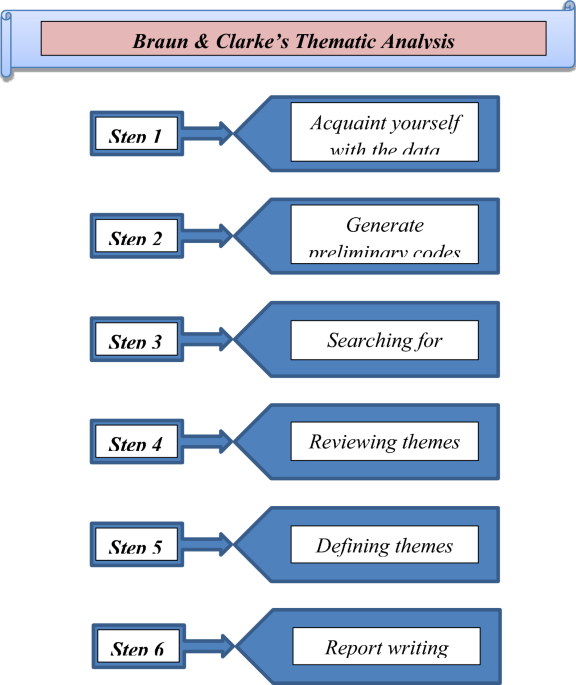
This study examined themes that emerged from interviews to provide detailed insights into obstacles, challenges, and optimal procedures in implementing RPA in the hotel industry. The results classify codes according to the pre-implementation, implementation, and post-implementation phases. Table 2, which emphasizes frequencies, highlights five significant themes for each important phase for hotel organizations and the critical role that the implementation phases play in ensuring successful RPA adoption.
Pre-implementation phase
The pre-implementation phase of an RPA system in the hotel industry requires careful consideration. Some of the activities essential to ensure a solid grounding for an RPA implementation that takes place as part of this phase include developing clear goals, selecting the right processes for automation, aligning stakeholders, conducting feasibility studies, and identifying potential vendors (see Fig. 3). These practices ensure the hotel is well-prepared to adopt RPA effectively by minimizing risks and maximizing potential benefits. To align with the strategic ambitions and readiness for future challenges, hotels can lay a solid foundation for their RPA ventures by addressing the following five key aspects.

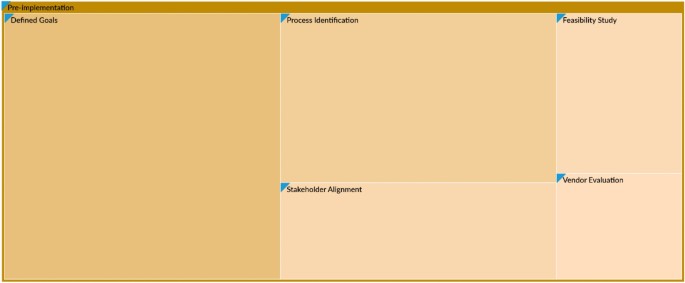
CSFs for the RPA pre-implementation phase.
Defined goals
During pre-implementation, hotels must define specific goals for their RPA initiatives. Establishing goals ensures that the project is scoped properly and aligned and confirms that the RPA implementation supports the hotel’s overall business plan. This means identifying which KPIs will be the benchmark for the automation project’s success, whether that’s lower operating costs, enhanced customer service, or improved process efficiency. As one participant stated regarding this topic:
“Our primary goal with RPA is to significantly reduce check-in/check-out times by automating guest data processing. This will not only expedite the guest experience but also free up staff to focus more on personalized service and guest satisfaction.” (R4).
Process identification
The processes that can be automated are then systematically identified and selected at the next stage. Hotels most often focus on high-volume, repetitive work that takes up a lot of time and resources, such as invoicing, check-in/check-out processing, and reservations management. By utilizing the appropriate procedures, hotels can ensure that operationalizing RPA is concentrated in those areas with the biggest scope for cost and performance benefit. According to one of the respondents:
“Identifying processes suitable for automation requires a thorough analysis of our current workflows and pain points. We’re conducting detailed process mapping exercises to pinpoint areas that are highly repetitive, time-consuming, and prone to human error.” (R5).
Stakeholder alignment
Stakeholder alignment must be ensured for RPA to be implemented successfully. This entails interacting with all relevant parties, such as front-line staff, IT personnel, and hotel management, to get their support and involvement. Aligning stakeholders makes handling issues easier, controlling expectations, and promoting a cooperative atmosphere. The involvement of stakeholders and communication are key to minimizing resistance to change and enhancing the performance of the RPA project. One respondent remarked on this issue that:
“Stakeholder alignment involves ensuring that every department understands how RPA will benefit their specific functions and contribute to our hotel’s overarching success.” (R12)
Feasibility study
Qualified processes undergo a thorough feasibility study to evaluate their technical and economic feasibility. The potential cost, benefit, and risk of RPA are examined at this stage. The responsibilities for this process include assessing the current procedures, identifying potential stumbling blocks, and determining the ROI. Conducting a feasibility assessment will ensure that the hotel is ready for the implementation phase and that the selected operations are suitable for automation. One respondent notes that:
“Conducting a feasibility study involves assessing the technical, financial, and organizational aspects of RPA implementation. We’re looking at factors such as the complexity of our existing IT infrastructure, the availability of skilled resources, and the potential return on investment.” (R7).
Vendor evaluation
Choosing an optimal RPA software vendor is crucial as part of a pre-implementation strategy. Hotels need to make a close analysis of potential suppliers based on their qualifications, status, and fit for the specific needs. This is the practice of looking at vendor rosters, client recommendations, and the support and training offered by software companies. An expansive vendor evaluation facilitates the selection of a partner equipped to provide the resources, support, and expertise necessary to ensure a successful and effective RPA implementation. One of the respondents stated that:
“When evaluating vendors, we’re looking beyond just the technology to assess their understanding of our industry’s unique challenges and requirements. We’re seeking vendors with proven experience in the hospitality sector and a track record of successful RPA implementations.” (R9).
Implementation phase
The pre-implementation phase planning and preparations of the hospitality industry are actualized into practical steps during the RPA implementation phase. The dedicated project team setup, process standardization, detailed project plan, as well as the documentation of work processes and scalable architecture design, are the crucial steps of this stage (see Fig. 4). All these entities are necessary for the smooth and successful deployment of the RPA solution, which increases hotel operation productivity and efficiency.
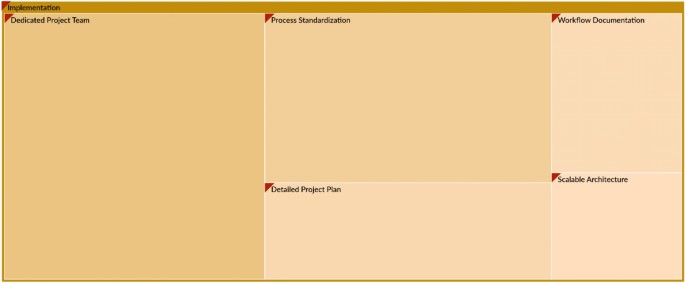
CSFs for the RPA implementation phase.
Dedicated project team
Supervising the RPA implementation process requires a dedicated project team. A well-rounded team should include specialists in project coordination, information systems, and process engineering to ensure effective implementation. Their combined expertise and dedication are essential for overseeing the project schedule, resolving technical issues, and ensuring the RPA system follows the operational objectives. Throughout the implementation phase, having a committed team guarantees responsibility and focused attention. According to one of the participants:
“We’ve assembled a dedicated project team comprising members from various departments, each bringing unique expertise and perspectives to ensure comprehensive project oversight.” (R1).
Process standardization
Standardizing a process is essential to ensuring consistency and efficiency before automating it. Process standardization entails evaluating and improving current protocols to get rid of variances and inefficiencies. Hotels can guarantee the smooth and reliable operation of the RPA system, lowering the probability of errors and improving overall operational efficiency, by developing a standard set of procedures. Process standardization offers a strong basis for efficient automation. As noted by one respondent about this topic:
“Process standardization involves identifying best practices and creating uniform procedures to ensure consistency and efficiency across all areas of operation.” (R5)
Detailed project plan
Implementing the RPA requires a dedicated project team to manage the process. The project team uses this plan as a roadmap to help them through every step of the implementation process. It has precise deliverables, deadlines, and backup plans in case something goes wrong. An organized project plan makes it easier to stay focused, manage resources effectively, and make sure the project stays on schedule and under budget. One participant remarked on this issue that:
“Our detailed project plan outlines every step of the implementation process, including timelines, milestones, resource allocation, and risk management strategies.” (R3)
Workflow documentation
Workflows must be thoroughly documented for the automated procedures to be consistent and clear. This entails mapping out every process that will be automated in great detail, including all of the processes, inputs, outputs, and decision points. The project team uses workflow documentation as a guide to understand how processes should operate in their current condition and after automation. It is necessary for future scalability, troubleshooting, and training. One of the participants mentioned that:
“Comprehensive workflow documentation serves as a reference point for both the project team and RPA developers, ensuring accurate replication and automation of tasks.” (R8)
Scalable architecture
A scalable architecture must be created to support future expansion and growing automation requirements. Growing transaction volumes and more complicated procedures can be handled by scalable RPA systems without necessitating extensive reengineering. This entails selecting reliable, versatile technology and planning the system for future growth. Long-term value and adaptability are provided by scalable design, which guarantees that the RPA implementation can change to meet the needs of the hotel. An explanation of one respondent’s remarks is provided below:
“Scalable architecture ensures that our RPA solution can handle increased workload demands without compromising performance or requiring significant redesign.” (R10)
Post-implementation phase
The post-implementation stage is the basis for maintaining long-term performance and sustainability benefits of RPA in the hotel industry. To ensure satisfactory operation of the RPA and its easy adaptation to various requirements, this phase concentrates on continuous monitoring, performance metrics, ongoing training, support system, and regular maintenance (see Fig. 5). Efficient control at this stage allows for the performance of automated operations and promptly eliminates the negative impact, ensuring further benefits from RPA.
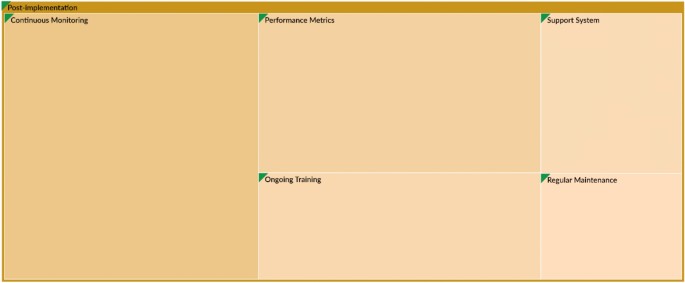
CSFs for the RPA post-implementation phase.
Continuous monitoring
Continuous monitoring is actively monitoring the RPA system for proper functioning and performance to ensure it performs as expected. This includes monitoring of automation in real time to detect blockages or errors. Enabling a high level of operational performance, achieving rapid identification and solution of issues, and ensuring that the RPA system continually meets the desired levels of performance requires continuous monitoring. As expressed by one participant on this matter:
“Continuous monitoring ensures that our RPA processes are running smoothly and identifies any issues or bottlenecks that require immediate attention.” (R3)
Performance metrics
Determining and monitoring performance indicators is critical to assessing the effectiveness of RPA implementation. These measures include process cycle times, mistake rates, cost reductions, and customer satisfaction levels. Hotels may evaluate how RPA is affecting their operations, pinpoint areas for development, and make data-driven choices to raise the efficiency and performance of automated procedures by examining these KPIs. One respondent claims that:
“Performance metrics provide valuable insights into the impact of RPA on operational efficiency and enable data-driven decision-making for further optimization.” (R2)
Ongoing training
Staff members must receive ongoing training to stay current on RPA procedures and tools. As RPA technology advances and new functionalities are added, ongoing training guarantees that staff members maintain system proficiency. This entails frequent workshops, training sessions, and resource updates. Staff members who receive ongoing training are better able to utilize the RPA technology and apply automation to their everyday work. The following is an explanation of one respondent’s comments:
“Providing ongoing training ensures that our staff remain proficient in using RPA tools and techniques, empowering them to leverage automation effectively.” (R5)
Support system
Establishing a strong support system is essential for handling any technical problems and offering help to RPA system users. Having a specialized helpdesk, a technical support staff, and well-defined escalation protocols are all part of this. A robust support system makes sure that any interruptions are promptly fixed, reducing downtime and preserving uninterrupted operations. It also assures users that they can trust the RPA system with important tasks. The following is an example of the participant’s response.
“We’ve implemented a robust support system comprising dedicated helpdesk support and documentation resources to assist users with any RPA-related queries or issues.” (R7)
Regular maintenance
Routine checks and upgrades are part of regular maintenance, guaranteeing that the RPA system performs at its best. Performance optimization, system audits, and software updates fall under this category. Frequent maintenance prolongs the life of the RPA, enhances system performance, and helps to avert possible problems. It guarantees that, throughout time, the automation system will continue to be reliable, safe, and able to support the operating requirements of the hotel. Concerning these themes, the response of one of the respondents is explained as follows:
“Regular maintenance activities, such as software updates, patch management, and system backups, are essential for preserving the integrity and performance of our RPA infrastructure.” (R9).
Figure 6 shows a detailed model with the CSFs for RPA adoption in the pre-implementation, implementation, and post-implementation phases. Each step is original and woven of the elements of the whole. The model provides a systematic understanding of the components that are required for effective adoption of RPA by practitioners and a formal basis for researchers to address the barriers to RPA adoption.

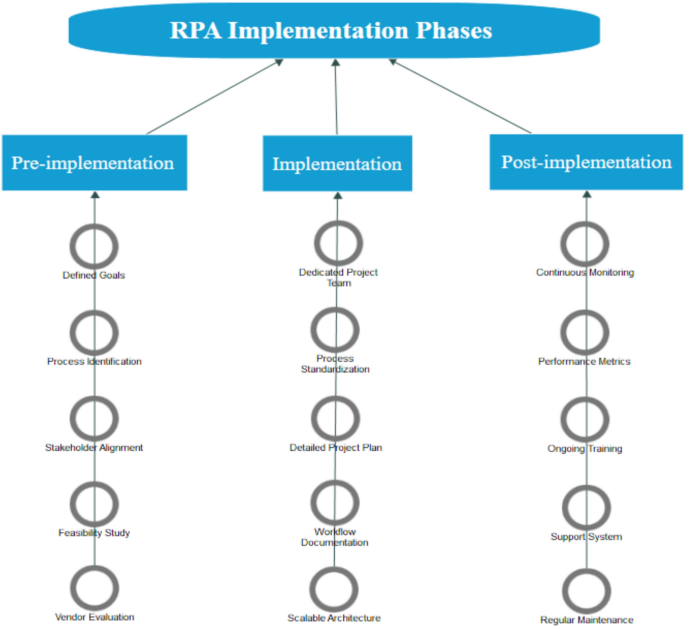
The final model of the adoption of RPA.
link